









Digital surveillance has become an invisible threat lurking in our daily lives. Your smartphone tracks every move. Hackers can access your webcam without warning. Credit card skimmers steal data through radio waves.
TL;DR for Privacy-Conscious Users
Quick Protection Checklist:
-
Webcam covers block unauthorized camera access (99% effective against visual surveillance)
-
Faraday bags eliminate all wireless signals (100% signal blocking when properly sealed)
-
RFID blockers prevent contactless card theft (blocks 13.56 MHz frequencies)
|
Privacy Gadget |
Protection Level |
Price Range |
Best Use Case |
|
Webcam Covers |
High |
$5-15 |
Daily computer use |
|
Faraday Bags |
Complete |
$20-150 |
Device storage, EMP protection |
|
RFID Blockers |
Medium-High |
$10-50 |
Wallet protection |
Webcam Covers: Your First Line of Defense
Webcam hacking affects millions of devices yearly. Malicious software can activate cameras without triggering indicator lights on many laptops and smartphones. Remote access tools (RATs) allow hackers to monitor victims for months without detection.
Physical webcam covers provide foolproof protection against visual surveillance. Unlike software solutions, they work regardless of malware infections or system compromises.
Slide-Based Webcam Covers
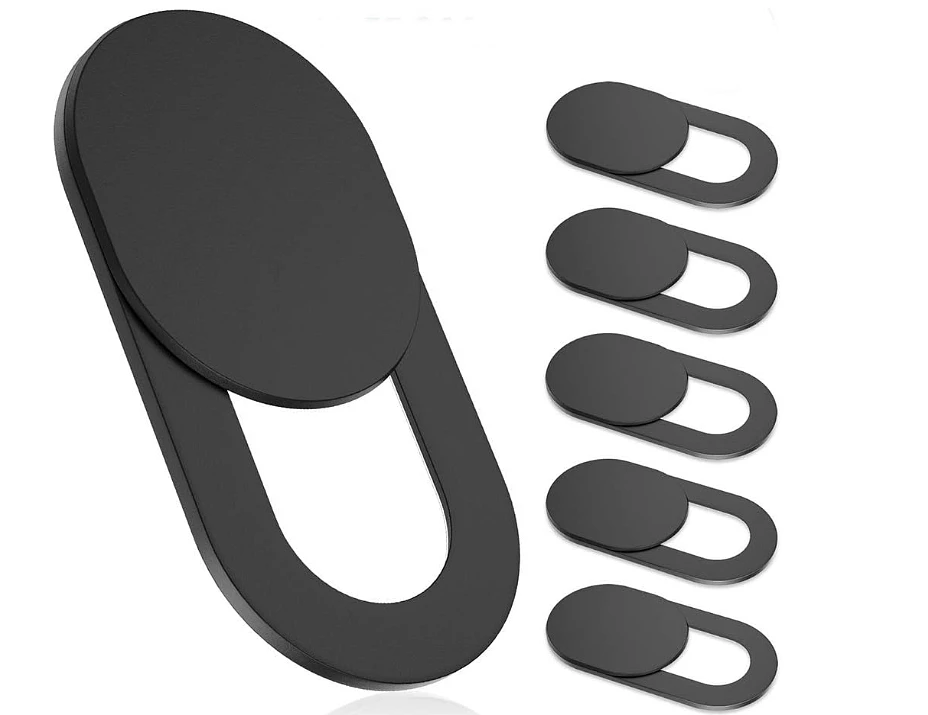
Kape Webcam Cover offers ultra-thin protection at just 0.2mm thickness. This adhesive-mounted cover slides smoothly without interfering with laptop closure. Installation takes seconds – clean the camera area, peel the backing, and press firmly.
Key specifications:
-
Thickness: 0.2mm (won't prevent laptop from closing)
-
Material: Durable plastic with smooth sliding mechanism
-
Compatibility: Universal fit for laptops, tablets, smartphones
-
Installation: Strong 3M adhesive, no residue removal
Magnetic Webcam Covers
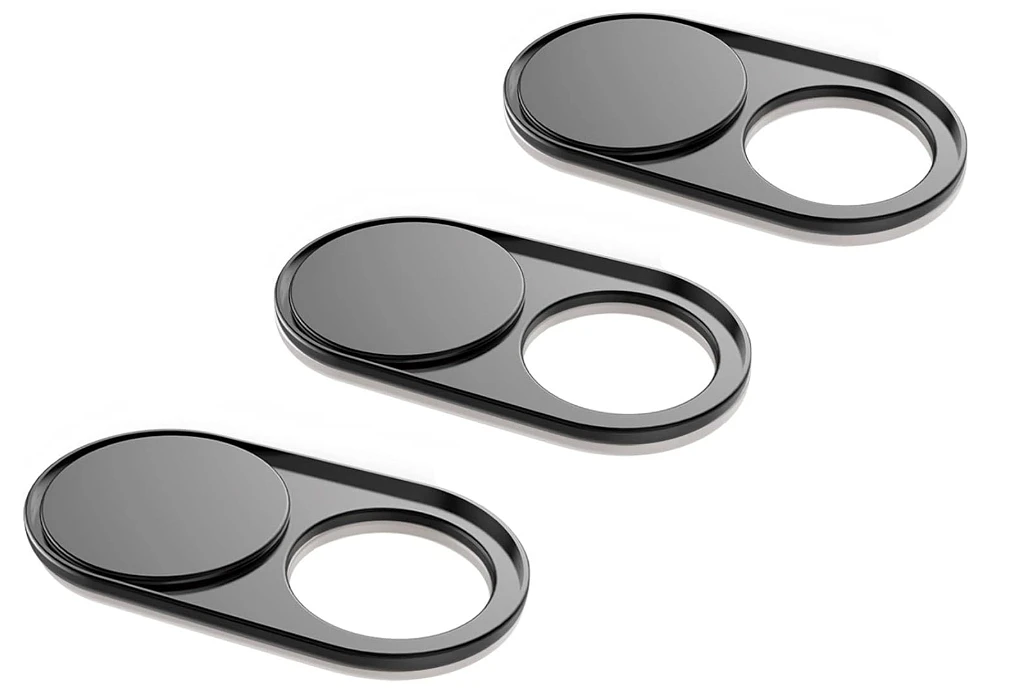
Elecom Magnetic Webcam Cover uses strong neodymium magnets for secure attachment. This ultra-thin design works on devices with metal frames or magnetic-compatible surfaces.
Key specifications:
-
Attachment: Magnetic (no adhesive required)
-
Thickness: 0.3mm profile
-
Compatibility: MacBooks, Surface devices, metal-framed tablets
-
Durability: Scratch-resistant surface coating
Magnetic covers offer reusability and repositioning flexibility. Perfect for shared devices or users who frequently switch between multiple computers.
Faraday Bags: Complete Signal Protection
A Faraday cage is a signal-proof enclosure. Its conductive mesh—often copper or nickel—forms a barrier that intercepts and disperses electromagnetic radiation. The critical factor is the seal: any imperfection, no matter how small, compromises the entire system. A fully sealed unit creates absolute digital isolation.
Inside, all wireless communication simply ceases. Cell networks, Wi-Fi, Bluetooth, GPS, and RFID signals cannot penetrate the barrier. Nothing gets in. Nothing gets out.
How Faraday Bags Actually Work
True electromagnetic shielding isn't just about metal—it's about using conductive materials to catch and reroute radio frequency energy. The best Faraday bags don't rely on a single layer; they employ multiple sheets of specialized fabric. These fabrics are precisely woven with micro-thin fibers of copper, silver, or nickel. This layered, material-specific construction is what creates an effective barrier, turning the bag into a functional shield rather than a simple pouch.
Effectiveness depends on three factors: material conductivity, mesh density, and seal integrity. Gaps larger than the wavelength being blocked allow signal leakage. This explains why cheap bags often fail – they lack proper sealing mechanisms or use insufficient conductive materials.
Professional testing uses spectrum analyzers to measure signal attenuation across different frequencies. Military-grade bags achieve 60+ dB attenuation (99.9999% signal blocking) from DC to 40 GHz.
Mission Darkness Non-Window Faraday Bag
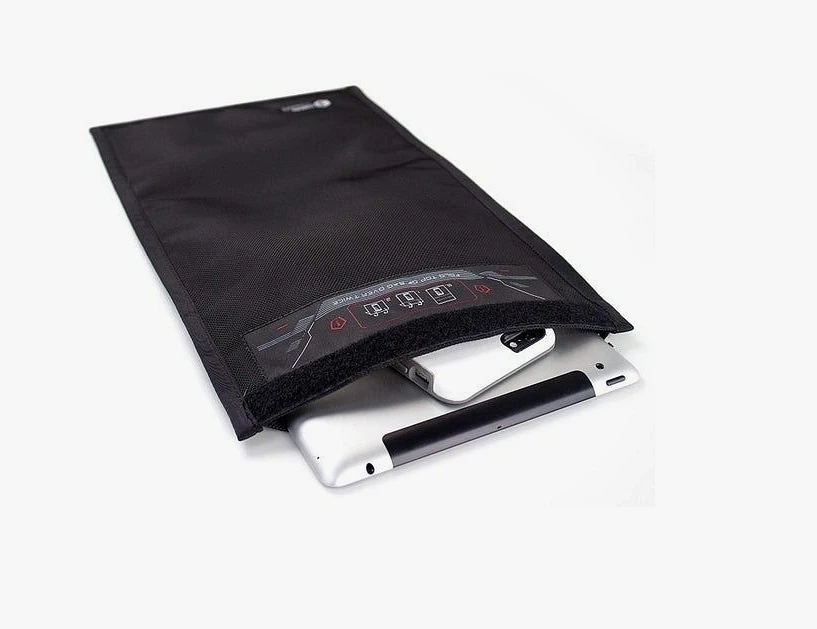
Mission Darkness Non-Window Faraday Bag provides laboratory-tested signal blocking with dual-layer TitanRF shielding. This professional-grade solution offers complete electromagnetic isolation for tablets, laptops, and multiple devices.
Detailed specifications:
-
Interior dimensions: 13 × 9.5 inches (accommodates most tablets and small laptops)
-
Shielding effectiveness: 60+ dB attenuation from 10 MHz to 40 GHz
-
Construction: Dual TitanRF Faraday fabric layers with ballistic nylon exterior
-
Closure system: Roll-top design with dual-sided conductive tape seal
-
Water resistance: IPX4 rating protects against splashes and light rain
-
Compliance: Berry Compliant materials (made in USA)
Best applications:
-
EMP protection for critical electronics
-
Forensic device isolation
-
Multi-device storage and transport
-
High-security environments requiring complete signal isolation
RFID Blockers: Protecting Your Digital Wallet
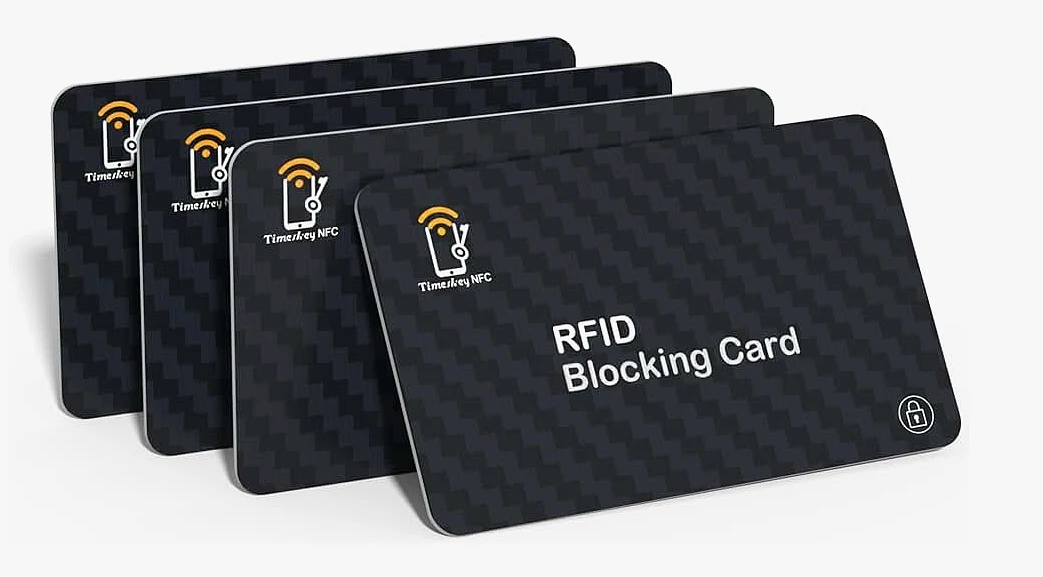
Criminals have turned RFID's convenience against us. That effortless tap-to-pay? The same tech lets a thief with a cheap, portable reader harvest your card's data from a pocket or purse—no contact, no clue. This is digital pickpocketing, happening right now.
The defense is pure physics. RFID-blocking gear uses a thin metallic mesh. This isn't a fancy filter; it's a Faraday cage. This mesh creates an electromagnetic barrier, caging that signal completely. A well-made blocker doesn't weaken the read range; it achieves near-total attenuation, specifically targeting the 13.56 MHz frequency used for payments. The signal is dead on arrival.
Why does this matter? The data payload is a goldmine. Your credit card, debit card, and passport are constantly broadcasting. Every attempted handshake transmits a packet of your most sensitive information: account number, expiration date, full name. That’s the complete suite of data required to clone a card or run fraudulent online transactions. The entire vulnerability is a direct trade-off for the wireless convenience we’re sold.
Implementation Guide: Building Your Privacy Toolkit
Step 1: Threat Assessment
Identify your specific privacy risks based on lifestyle, work requirements, and device usage patterns. High-risk users include executives, journalists, activists, and frequent travelers.
Step 2: Device Inventory
List all devices with cameras, wireless capabilities, or RFID components. Include smartphones, laptops, tablets, key fobs, payment cards, and work badges.
Step 3: Protection Prioritization
-
Immediate: Webcam covers for all camera-equipped devices
-
Essential: RFID-blocking wallet for payment cards and ID documents
-
Advanced: Faraday bags for sensitive devices and high-risk situations
Step 4: Budget Planning
Basic privacy protection costs $50−100 for essential gadgets. Comprehensive coverage including professional−grade Faraday bags ranges $200-400. Consider protection value versus replacement costs for expensive devices.
Step 5: Testing and Verification
Verify effectiveness using simple tests. Call your phone while it's in a Faraday bag – no signal should get through. Test RFID blockers using contactless payment attempts.
FAQ
Do Faraday bags actually block every signal?
A high-quality Faraday bag, when sealed correctly, is remarkably effective. Lab tests confirm signal attenuation exceeding 60 dB—that translates to blocking 99.9999% of transmissions. This effectiveness spans a massive range: 10 MHz all the way up to 40 GHz. We're talking cell service, Wi-Fi, Bluetooth, GPS, and RFID. All blocked.
But here’s the critical part: the seal is everything. Any gap, fold, or wear on the bag's conductive lining creates a leak. Cheap, flimsy bags are basically useless; their material is subpar and their closures don’t create a consistent EMI shield.
Will a Faraday bag save my gear from an EMP?
It's a mixed bag. Military-spec Faraday cages are designed for this, offering solid protection for small devices like a phone or radio. However, success isn't guaranteed. It hinges on the pulse's raw power, the bag’s construction quality, and the specific device’s hardening.
Serious EMP shielding isn’t a simple pouch. It requires specialized engineering: multiple shielding layers, dedicated grounding, and fully sealed containers. Consumer Faraday bags provide a basic level of defense but cannot be relied upon for a severe, high-altitude EMP scenario. They're better than nothing, but not a magic bullet.
My webcam has a light. Do I still need a cover?
Yes. Absolutely. That indicator light is a software-controlled component, not a physical failsafe. It can be hacked. Sophisticated malware has repeatedly been shown to activate cameras while keeping the light off—a common tactic in targeted surveillance.
Do RFID blockers interfere with legitimate card reading?
RFID blockers, when properly constructed, don’t interfere with legitimate use. Their operation is entirely situational. The core mechanism is a passive shield—typically a metallic alloy mesh—that must form a complete enclosure to function. It’s a faraday cage for your pocket.
Seal the wallet or sleeve, and the cage is active, blocking all electromagnetic fields. Open it to pay, and you’ve broken the cage’s continuity. The reader’s signal now accesses the card unimpeded. This on/off dynamic is the critical feature.
There’s no signal jamming or data scrambling involved. Quality blockers are inert; they don’t transmit or degrade your card’s strip or chip. The protection is physical, not digital. It exists only when the container is closed and vanishes the instant you present the card, ensuring zero friction during a legitimate transaction.